What’s the Cheapest Way to Buy Bitcoin in 2026?
Last updated: 25/08/2026. Fee schedules verified against each platform’s official pricing page on this date.
- Why the interface matters more than the exchange
- Every buying route, compared
- Buying Bitcoin from crypto exchanges
- Buying Bitcoin from wallets
- Buying Bitcoin through payment apps
- Buying Bitcoin in the EU: what MiCA changed
- Earning free Bitcoin
- Other ways to buy Bitcoin
- Bitcoin, shortly
- FAQs
- In conclusion
Most people asking how to buy Bitcoin cheaply assume the answer is “pick the right exchange.” It usually isn’t. The bigger cost is which interface you use on the exchange you already have. We ran the same $50 purchase two ways on one Coinbase account, minutes apart. Through the simple Buy button it cost nearly 2%. Through the pro terminal it cost 0.60%. That gap – plus the spread quietly baked into the quoted price – is where nearly all of your money goes. This guide breaks down what you actually pay across the major exchanges, wallets, payment apps, ATMs and ETFs, where the hidden costs sit, and which route makes sense at which size. One thing before the numbers: the cheapest purchase is worthless if you lose the coins. Buy from a regulated platform, and move anything you intend to hold long-term off the exchange.
Why the Interface Matters More Than the Exchange
Almost every major exchange runs two pricing models under one login, and most users never notice the second one exists. The first is the consumer app – a big Buy button, a quoted price, one confirmation screen. The second is the order-book terminal: Coinbase Advanced Trade, Kraken Pro, the Crypto.com Exchange. Same company, same account, same Bitcoin, and often several times the cost difference. Three things drive that gap.
The spread
Consumer interfaces build a markup into the price they quote rather than showing it as a line item. You are not buying at the market price; you are buying at the market price plus a margin. Pro terminals quote the real order book and charge a visible fee instead.
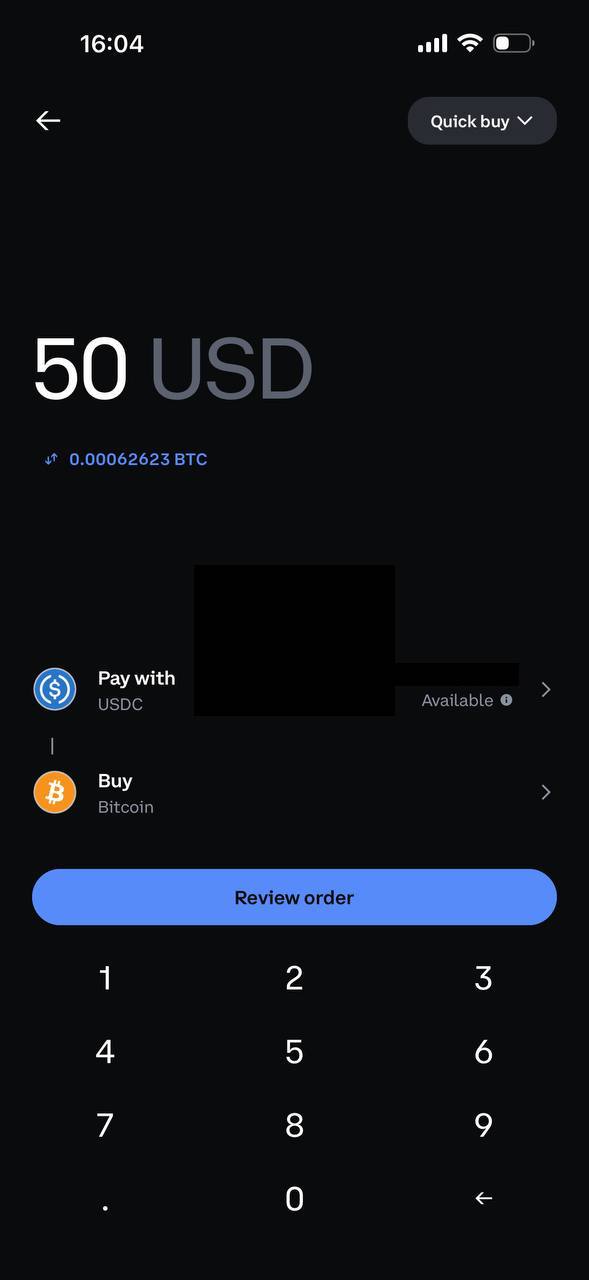
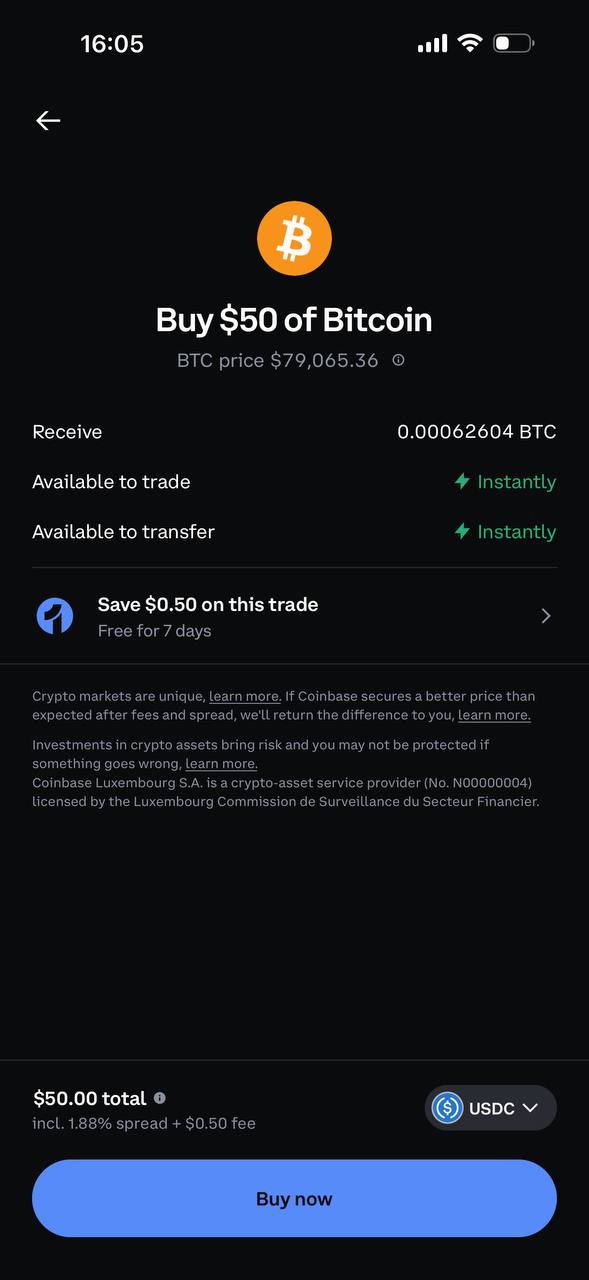
A platform advertising “zero fees” is almost always earning on spread – which is why comparing advertised fee percentages is close to useless. Compare the amount of BTC that actually lands in your account.
We ran this ourselves. A $50 Bitcoin purchase through Coinbase’s simple flow quoted 0.00062623 BTC, with no cost shown on the entry screen at all. The review screen disclosed it: a 1.88% spread plus a $0.50 flat fee. That is roughly $1.44 on a $50 buy.
Note how the flat fee behaves at small sizes. Fifty cents on $50 is a full 1% by itself – which is why small, frequent purchases are proportionally the most expensive way to accumulate.
Maker versus taker
On an order-book terminal, a market order fills instantly by consuming someone else’s liquidity. That is a taker order, and it costs more. A limit order that sits on the book until the market reaches your price adds liquidity – a maker order, which costs less.
On most schedules the maker rate is a third to a half of the taker rate.
But a limit order alone is not enough, and this is where most guides go wrong. If you price your limit order so it fills immediately, you are still consuming liquidity – still a taker, still charged the higher rate.
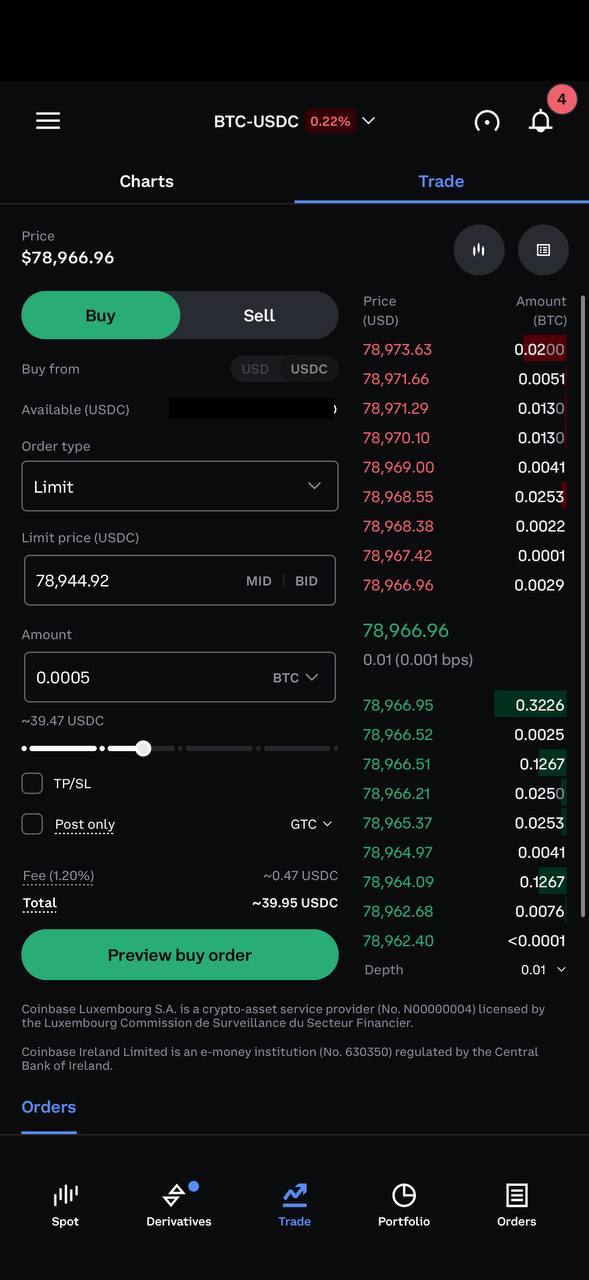
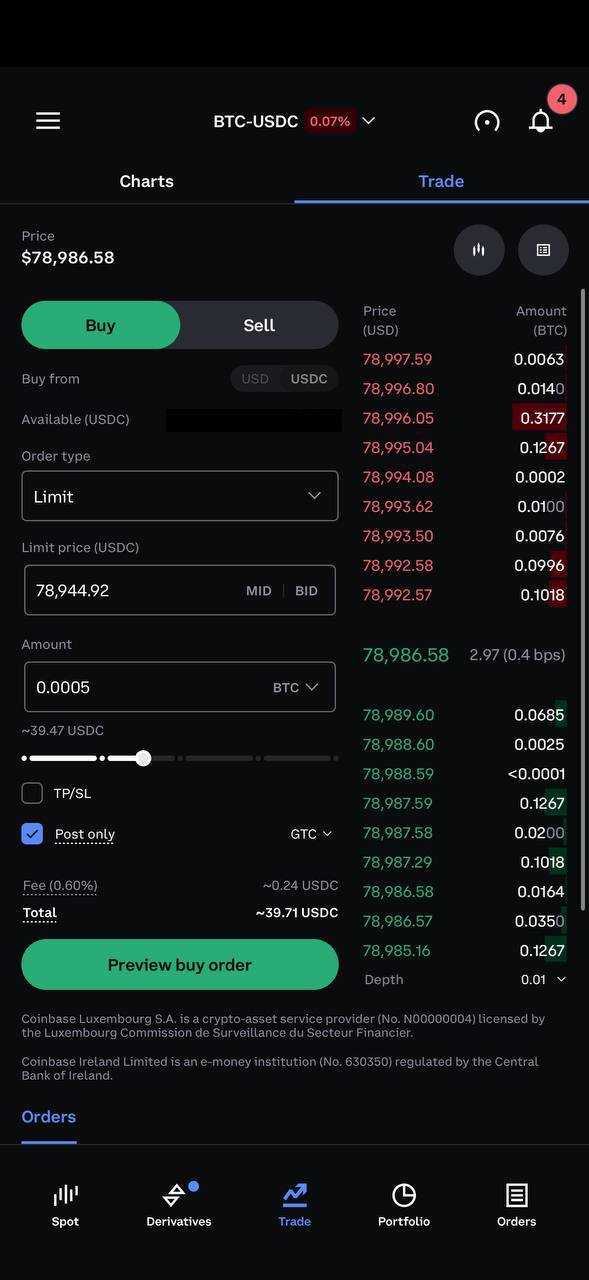
The setting that actually earns you the maker fee is Post only. It forces the order to rest on the book and cancel rather than fill instantly. In our test the fee halved from 1.20% to 0.60% – about $0.47 down to $0.24 on the same order – with nothing changed but that checkbox.
There is a genuine trade-off. Post only guarantees the maker rate, but the order will not fill unless the market comes to your price. If Bitcoin runs away from you, it simply sits there. You are exchanging certainty of execution for a lower fee – sensible for planned accumulation, less so if you need to be in immediately.
Funding method
Card purchases are the most expensive way to fund any account, everywhere, without exception. Bank transfer – SEPA in the EU, ACH in the US, Faster Payments in the UK – is usually free or near-free. The convenience premium on a card can exceed the entire trading fee several times over. Beyond these three, network transaction fees apply when you move Bitcoin off an exchange. Those fluctuate with how busy the Bitcoin network is and have nothing to do with your platform. They are a fixed cost per withdrawal, which makes frequent small withdrawals disproportionately expensive – batch them.
Every Buying Route, Compared
With that in mind, here is how the main routes stack up, cheapest first. The figures are entry-tier rates – what you actually pay before any volume discount, taking the cheapest available path on that platform.
| Platform | Cheapest route & cost | What to watch |
|---|---|---|
|
Crypto.com
Cheapest to start
|
0.25% / 0.50%
Exchange interface, limit order
|
Lowest entry-tier rate of the three, but the in-app buy flow is priced separately and higher. Staking CRO drops your tier further. |
|
Kraken
Best above $10K
|
0.40% / 0.80%
Kraken Pro terminal, limit order
|
Drops to 0.22% / 0.38% from $10K monthly volume – or $20K held on the platform, since tiers now qualify on assets too. Avoid Instant Buy at 1%. |
|
Coinbase
Priciest of the three
|
0.60% / 1.20%
Advanced Trade, limit order
|
Double the taker rate of Kraken’s entry tier. The default app adds a spread of up to ~1.9% on small buys. Stablecoin pairs are 0.00% maker at any tier. |
|
Spot Bitcoin ETF
Annual charge
|
0.14–0.25%
Per year, via any brokerage
|
Charged annually on your whole holding, not once per trade. You own exposure, not coins – no keys, no custody risk. |
|
PayPal
Expensive
|
1–2.4%
Spread – only one flow available
|
US and UK in full, EU coverage patchy. UK buyers face a cooling-off period and cannot buy on credit. |
|
In-wallet buy button
Expensive
|
3–5%
Third-party card processor
|
Routed to MoonPay, Ramp or similar. Buying on an exchange and withdrawing to the same wallet is usually cheaper, even after network fees. |
|
Bitcoin ATM
Most expensive
|
10–25%
incl. rate markup
|
$40–$100 on a $500 buy, against about a dollar on a pro terminal. What you get is cash access and minimal verification. |
Buying Bitcoin from Crypto Exchanges
Exchanges remain the cheapest practical route for most buyers. The trade-off is that you take on account security responsibility, and you need to understand a fee schedule rather than a single headline number. The exchange does not set every cost you pay. Network transaction fees fluctuate with Bitcoin network activity, and payment processors add their own charges on certain funding methods. The exchange’s schedule is the part you can control – the rest is the cost of the rails.
Coinbase
Coinbase is among the most trusted cryptocurrency exchanges, offering a wide range of trading and custody services. Founded in 2012 by Brian Armstrong and Fred Ehrsam, it is a NASDAQ-listed company holding money transmitter licences across all 50 US states – which is precisely why its fees run higher than offshore competitors, and precisely why US institutions use it anyway. Coinbase serves beginners and active traders through two interfaces. The default app is built around onboarding, payment flexibility and convenience. Advanced Trade is the order-book terminal, free to access from the same account.
Coinbase fees
The default app builds a spread into every quoted price and adds a flat fee on top. In our own test, a $50 purchase carried a 1.88% spread plus $0.50 – spreads widen on smaller orders, so treat that as the small-buy end of the range rather than a universal figure. Advanced Trade removes the spread entirely and prices by maker/taker tier based on your trailing 30-day trading volume – calculated across every order book, not on your account balance, and applied at the tier you occupy when the order is placed.
One bright spot: eligible stablecoin pairs carry 0.00% maker fees and minimal taker fees regardless of tier. If your route into Bitcoin runs through USDC, Coinbase Advanced is legitimately cheap.
Coinbase One runs three tiers – Basic ($4.99/month, fee-free up to $500), Preferred ($29.99, up to $10,000) and Premium ($299.99, uncapped). Read the exclusions carefully, though: zero trading fees apply to simple trades only, and Coinbase Advanced is explicitly excluded – a spread still applies to the simple flow either way. Advanced users get a 25% rebate on spot fees instead, capped at 100 USDC a month on the Preferred tier. If you follow this guide’s advice and trade on Advanced, the subscription is worth far less than the headline suggests.
Watch for the upsell timing, too: the offer to waive that $0.50 fee appears on the review screen, at precisely the moment the cost becomes visible. It waives the flat fee – not the spread, and not anything on Advanced Trade.
| Your 30-day volume | Maker (limit order) | Taker (market order) |
|---|---|---|
| Under $1,000 – most retail buyers | 0.60% | 1.20% |
| $1,000+ | 0.35% | 0.75% |
| $10,000+ | 0.25% | 0.40% |
| $50,000+ | 0.15% | 0.25% |
| $500,000+ | 0.10% | 0.20% |
Rates verified on the platform’s official fee page on 25/08/2026. Lower tiers exist above $1M in monthly volume, bottoming out at 0.00% maker and 0.03% taker. Tiers can also be reached through 30-day perpetuals volume or total asset balance, whichever qualifies you highest.
Payment methods
- Bank transfer (ACH for US customers, SEPA for EU investors);
- Credit or debit card;
- PayPal;
- Apple Pay and Google Pay;
- 3D Secure card;
- Multiple fiat currencies (CAD, EUR, GBP, SGD, USD and others);
- Crypto deposits from external wallets.
Bank transfer is the cheapest of these by a wide margin. Card and wallet-based payments carry processor fees on top of whatever Coinbase charges.
Security
Coinbase encourages two-factor authentication and keeps the majority of customer assets in cold storage, holding only a small float in hot wallets to process withdrawals quickly. It also employs multi-party computation, which splits the cryptographic keys for on-chain transactions into separate fragments so no single compromised system can move funds.
How to buy Bitcoin on Coinbase – the cheap way
- Log in and switch to Advanced Trade, not the default Buy button.
- Fund the account by bank transfer (ACH or SEPA), not card.
- Select the BTC-USD or BTC-EUR order book.
- Set Order type to Limit, tick Post only, and set your price at or below the current best bid. A limit order priced to fill immediately is still charged the taker rate – Post only is what guarantees the maker fee.
- Review and confirm. The order fills when the market reaches your price.
Using the simple Buy button is faster, but costs the spread plus a higher fee – on a recurring purchase that difference compounds into real money over a year.
Kraken
Kraken launched in 2011 in San Francisco and now supports 450+ digital assets across 190+ countries. Buying on the standard interface is as simple as beginners expect; the Kraken Pro terminal is where the savings live. Kraken Pro is available on web and mobile and gives access to detailed asset data, live charts and open-order management. The interface looks intimidating at first and takes about one session to get comfortable with – a very good hourly rate for what it saves.
Kraken fees
The interface split mirrors Coinbase. Kraken charges 1% on instant and recurring trades and 1.5% on custom orders, plus spread; Kraken Pro uses the tiered maker/taker schedule. Critically, Instant Buy volume does not count toward your fee tier – another reason to use Pro for everything, including small recurring purchases. SEPA deposits are typically free, crypto deposits are free, and card purchases are the expensive option – as on every platform in this guide. Fund by bank transfer wherever you can. Kraken+ is an optional $4.99/month subscription with zero trading fees on up to $10,000 in monthly volume, plus boosted stablecoin rewards. Spreads and card processing fees still apply.
| Your 30-day volume | Maker (limit order) | Taker (market order) |
|---|---|---|
| Under $2,500 – most retail buyers | 0.40% | 0.80% |
| $2,500+ | 0.30% | 0.60% |
| $10,000+ or $20K held | 0.22% | 0.38% |
| $25,000+ or $50K held | 0.20% | 0.35% |
| $50,000+ or $100K held | 0.15% | 0.30% |
Rates from Kraken’s official fee schedule, verified 25/08/2026. Tiers continue down to 0.00% maker and 0.05% taker at the highest volumes. Tiers can also be reached through 30-day futures volume or assets held on the platform, whichever qualifies you highest. Instant Buy carries a flat 1% fee (1.5% on custom orders) and does not count toward your 30-day volume.
Payment methods and security
Kraken supports Visa and Mastercard credit and debit cards, digital wallet funding, and bank transfers including ACH and SEPA. Supported fiat currencies include USD, EUR, CAD, AUD, GBP, CHF and JPY. On security, Kraken goes further than most: you can set different two-factor codes for sign-in, withdrawals and trades separately, and lock the account against any changes if you suspect a compromise.
How to buy Bitcoin on Kraken – the cheap way
- Log in and open Kraken Pro, not the Instant Buy screen.
- Deposit fiat by SEPA or ACH rather than card.
- Select the BTC/EUR or BTC/USD pair.
- Place a limit order with post-only enabled, priced at or below the best bid. A limit order that fills immediately is still charged the taker rate.
- Confirm and wait for the fill.
Crypto.com
Launched in 2016 in Hong Kong, Crypto.com lets you trade, buy and sell Bitcoin through a mobile-first app on iOS and Android, alongside a separate exchange interface. It now lists 400+ cryptocurrencies and reports over 150 million users across 90+ countries. Its distinguishing feature is the native CRO token. Holders who stake CRO receive reduced trading fees, which changes the calculation meaningfully if you are already in that ecosystem – and is worth nothing to you if you are not. Registration is quick, though identity verification is required before trading.
Crypto.com fees
Crypto.com operates a maker-taker model on its exchange, with the app-based buy flow priced separately and more expensively – the same two-tier pattern as its competitors. At the entry tier the Exchange charges 0.25% maker and 0.50% taker, the lowest of the three platforms here. Deposits can be made by SWIFT or SEPA bank transfer, alongside card payments and local rails including ACH, Faster Payments and PIX depending on your market. Card purchases carry a processor fee of roughly 1% to 3%.
Security
Crypto.com supports two-factor authentication and stores the bulk of customer funds offline. It works with US partner banks to provide FDIC insurance on USD balances up to the standard limit – note this covers the cash balance, not your Bitcoin.
| Your 30-day volume | Maker (limit order) | Taker (market order) |
|---|---|---|
| Under $10,000 – most retail buyers | 0.25% | 0.50% |
| $10,000+ | 0.20% | 0.40% |
| $50,000+ | 0.15% | 0.25% |
| $250,000+ | 0.10% | 0.20% |
| $500,000+ | 0.08% | 0.18% |
Rates from Crypto.com’s official fee schedule, verified 25/08/2026, shown without a CRO balance. Holding CRO on the exchange cuts the maker fee to 0% at every level and takes roughly 12% off the taker fee – 0.44% instead of 0.50% at the entry tier. These rates apply to the Exchange interface, not the simple in-app buy.
How to buy Bitcoin on Crypto.com
- Fund your account by SEPA or SWIFT transfer rather than card.
- Use the Exchange interface rather than the simple in-app buy.
- Select the BTC pair and place a post-only limit order.
- Confirm.
Other Exchanges Worth Comparing
The three platforms above are the most commonly recommended, but they are not the cheapest available, and a fee-focused guide should say so plainly. Several large exchanges – including Binance, OKX and Bitget – operate base spot fees substantially below the US-regulated platforms, with further discounts for holders of their native tokens. Binance’s standard spot tier sits at 0.10% for both maker and taker, against Coinbase’s 0.60%/1.20% entry rate. The trade-off is regulatory. US-listed and EU-licensed platforms carry compliance costs that show up in their fee schedules; that is what the premium buys. Whether it is worth paying depends on your jurisdiction, the size of your position, and how much weight you place on the exchange’s regulatory standing. Brokerage platforms are also increasingly viable. Robinhood, eToro and Revolut all offer Bitcoin purchases, generally with simpler interfaces and less favourable pricing than a pro terminal – though Revolut is convenient for European users already banking there, and Robinhood has recently expanded its regulated footprint in the UK.
Buying Bitcoin from Wallets
Many crypto wallets include a built-in buy button, and the process really is simple – a few taps move funds from your bank card directly into BTC held in your own wallet, with no exchange account required.
That said, wallets answer a different and equally important question: where your Bitcoin should live after you buy it. Non-custodial storage means you hold the private keys, which is the correct destination for any long-term holding regardless of where you purchased.
Trust Wallet
Trust Wallet is a non-custodial wallet founded by Viktor Radchenko in 2017 and acquired by Binance the following year. It is available on iOS and Android, and as an extension for Chrome, Brave, Opera, Edge and other browsers. App users can enable Face ID or Touch ID for an extra layer of protection. As a non-custodial wallet, its security ultimately rests on your ability to keep your recovery phrase safe – anyone with that phrase has your funds, and nobody without it can help you recover them. Storing assets is free. Trust Wallet states it charges $0 on buying, sending and receiving – you pay only the blockchain gas, with swap fees built into the exchange rate. The third-party card processor still takes its cut, which is where the real cost sits.
Coinbase Wallet (now Base app)
Coinbase’s self-custody wallet is a separate product from the Coinbase exchange account, and the distinction matters: the exchange holds keys on your behalf, the wallet does not. It was renamed Base App – announced at Coinbase’s “A New Day One” event in July 2025, with a global launch in December 2025 across more than 140 countries. It kept its self-custody core and added a social feed, mini-apps and encrypted messaging. Most people still search for it under the old name. Storing crypto is free; buying and swapping inside the wallet carries fees plus processor costs. One practical catch: Dogecoin and Litecoin work only in the legacy Coinbase Wallet mode, not the new Base experience.
Exodus
Exodus was founded in 2015 and is known for an unusually polished interface. It is non-custodial and supports 50+ blockchains and roughly 130 assets. In-wallet purchases carry a spread that varies with the amount bought and network conditions. Exodus is free to download and use. One caveat, stated plainly: Exodus does not support two-factor authentication. It offers Face ID, Touch ID and a desktop password instead. For a wallet holding meaningful value, that is a real limitation to weigh.
Buying Bitcoin Through Payment Apps
PayPal began supporting Bitcoin in October 2020 and has since expanded well beyond the US. Its native crypto hub – covering Bitcoin, Ethereum, Litecoin, Bitcoin Cash, Solana, Chainlink and its own PYUSD stablecoin – is available in the US and UK in full, plus select European jurisdictions. PYUSD itself has reached 70+ markets, but a stablecoin rollout is not the same as being able to buy Bitcoin: direct BTC purchase coverage across EU member states remains patchy, and the EU is still in an early PYUSD rollout phase. If you are in the EU, check availability in your own market before planning around it – the US and UK have full access, the rest of Europe does not. You are paying for convenience, and paying well over the odds for it. PayPal quotes a price including a markup over the underlying market rate – typically around 1% to 2.4% depending on order size – plus a small per-transaction fee on smaller orders. In the US the purchase ceiling is $100,000 per week with no annual cap, while moving crypto out to an external wallet is capped at $25,000 per week. New or unverified accounts start far lower. UK buyers should note two FCA-driven rules: a cooling-off period applies to first-time investors, and you cannot use PayPal Credit or borrowed money to buy crypto.
How to buy Bitcoin on PayPal
To buy BTC on PayPal, sign in and then:
- Open the Finances or Crypto section;
- Select Bitcoin, then Buy;
- Enter the amount you want to purchase;
- Choose a payment method and continue;
- Check the conversion rate and fees before confirming.
Your BTC is held in your PayPal account until you withdraw it to an external wallet or exchange.
Buying Bitcoin in the EU: What MiCA Changed
European buyers now operate under the Markets in Crypto-Assets regulation, and it has changed the landscape in ways that affect both cost and platform choice. Under MiCA, a platform authorised as a Crypto-Asset Service Provider in one EU member state can passport that authorisation across the entire EEA. Kraken holds a MiCA CASP authorisation from the Central Bank of Ireland and is now live across all 30 EEA countries under MiCA, with passporting of regulated services, and offers regulated derivatives to eligible EU clients through a MiFID II-licensed Cyprus entity. Three practical consequences for a European buyer:
- Check for CASP authorisation before opening an account. It is a meaningful signal about custody standards, disclosure requirements and what recourse you have if something goes wrong.
- SEPA is your cheapest funding rail. Most authorised platforms process SEPA deposits free or near-free, and it settles quickly. Card funding on the same platform can cost several percent.
- Some platforms have restricted or withdrawn certain products in the EU to comply. Availability in the US does not imply availability in your market – verify before planning around it.
Kraken’s EEA-wide authorisation covers Bulgaria. Coinbase One is also available to Bulgarian users, though as noted above its zero-fee benefit excludes Advanced Trade. Availability of individual products still varies, so check before you commit.
Earning Free Bitcoin
There are several ways to earn Bitcoin for free, though it is worth setting expectations before spending time on any of them:
- The amounts are small. Most rewards arrive in satoshis, the smallest unit of BTC;
- Withdrawal fees may consume a meaningful share of what you earned;
- Scams are common here. Research any project carefully before providing personal information or a wallet address.
Crypto airdrops
Airdrops are promotional events run by newly launched projects looking to build an audience. Prize pools may consist of the project’s own token or established assets such as Bitcoin, Ethereum or Tether. Participation typically involves simple tasks: following the project on social media (X, Instagram, Facebook), referring friends, joining Discord or Telegram channels, registering on the platform, or sharing specific posts. Treat any airdrop that asks for a seed phrase or private key as a scam, without exception. No legitimate distribution requires either.
Bitcoin faucets
Bitcoin faucets are websites that pay small amounts of BTC for simple actions – watching ads, solving CAPTCHAs, or playing basic games. As with airdrops, rewards are measured in satoshis. Consistency over a long period can accumulate a modest balance, but the hourly rate is poor.
Bonuses
Many platforms, exchanges included, offer sign-up bonuses for completing a first deposit, and some reward users for completing KYC verification. Only submit identity documents to platforms you have independently verified as legitimate. Learn-to-earn programmes are the more interesting variant: several exchanges pay small amounts of crypto for completing educational quizzes. Coinbase runs one under the name Learning Rewards. The amounts are small but the education is worth having if you are new.
Mining
CPU and GPU mining of Bitcoin is obsolete. The network is secured by purpose-built ASIC hardware, and the block reward has halved twice since 2020 – it now stands at 3.125 BTC. Competing profitably requires industrial-scale hardware and electricity priced far below household rates. Pool mining lets small operators combine hash power for more consistent payouts, but it does not change the underlying economics – it smooths the variance, not the margin. Cloud mining contracts are a well-documented scam vector and should be treated with extreme caution. If you already own Bitcoin and want it to generate yield, that is lending or a staking-adjacent product – a different subject with a very different risk profile, and not mining.
Other Ways to Buy Bitcoin
Bitcoin ATMs
Bitcoin ATMs let you buy BTC with cash, and they look reassuringly like ordinary bank machines. They are quick, they generally avoid lengthy verification, and in some jurisdictions they offer more privacy than an exchange account. They are also the most expensive route in this entire guide. Even at a legitimate machine, Bitcoin ATMs typically charge 10% to 25% all-in once the operator fee and the exchange-rate markup are combined – the Federal Reserve Bank of Kansas City puts the industry median near 16%. There is a further risk: operators vary enormously in reliability, and disputes over a machine that took cash without delivering coins are difficult to resolve. If you use one, choose an established operator and start with a small test amount. Bitcoin Depot, formerly the largest operator with over 9,000 machines, filed Chapter 11 bankruptcy in May 2026 and deactivated all machines. The global network is now shrinking rather than growing.
Spot Bitcoin ETFs
The SEC approved the first 11 US spot Bitcoin ETFs on 10 January 2024. The category has since become one of the fastest-growing in ETF history, with 13 funds now trading and collective assets well above $100 billion. BlackRock’s iShares Bitcoin Trust (IBIT) dominates by assets and has by far the deepest options market. Fidelity’s FBTC is second. Grayscale’s Bitcoin Mini Trust and Morgan Stanley’s MSBT – the first spot Bitcoin ETF issued directly by a major US bank, launched 8 April 2026 – compete at the low end on cost. Expense ratios across the category run roughly 0.14% to 0.25% annually. Morgan Stanley’s MSBT is currently the cheapest at 0.14%, with Grayscale’s Mini Trust at 0.15% and both IBIT and FBTC at 0.25%.
A structural point worth knowing: ten of the thirteen funds use Coinbase or a Coinbase affiliate for custody. Only Fidelity (via Fidelity Digital Assets) and VanEck’s HODL (via Gemini) are fully independent of it. For a large allocation, that concentration is a real consideration. ETFs trade on NYSE Arca and Nasdaq through any standard brokerage – Robinhood, eToro, Fidelity, Charles Schwab and others. Note that they trade only during market hours, while Bitcoin itself trades 24/7. Gaps can open between Friday’s close and Monday’s open.
Bitcoin, Shortly
Bitcoin is the first cryptocurrency, launched in 2009 by the pseudonymous Satoshi Nakamoto. It has remained the largest cryptocurrency by market capitalisation ever since. It reached an all-time high above $126,000 in October 2025 and has traded well below that peak through 2026. Bitcoin runs on a Proof of Work consensus mechanism: miners expend computational effort to solve cryptographic problems, and in doing so verify and confirm new transactions. Successful miners receive newly issued coins plus transaction fees. Confirmed transactions are grouped into blocks and appended to the blockchain, a decentralised ledger maintained across a global network of nodes. The block reward halves roughly every four years and currently stands at 3.125 BTC. Total supply is capped at 21 million coins.
FAQs
In Conclusion
If you take one thing from this guide, take this: check whether your exchange has a pro interface, and use it. That change costs nothing, takes one session to learn, and saves more than platform-hopping ever will. After that, in rough order of impact – watch the spread rather than the advertised fee, fund by bank transfer instead of card, use post-only limit orders rather than market orders, batch purchases rather than buying in dribs and drabs, and check whether a subscription tier beats per-trade pricing at your volume. Fee schedules change, sometimes substantially – Kraken rewrote its entire model this year. Verify current rates on the platform’s own pricing page before any significant purchase, and treat any guide quoting exact percentages, including this one, as a starting point rather than a final answer.
How We Tested
Every fee figure in this guide was taken from each platform’s own official pricing page on 25/08/2026, not from third-party summaries. Where sources disagreed, we deferred to the platform.
The Coinbase screenshots come from a live account on 25/08/2026, within a ten-minute window so that market conditions were effectively identical across all four. We entered the same purchase through the simple buy flow and through Coinbase Advanced, then changed a single setting at a time to isolate what each one costs. No orders were placed on behalf of a third party, and no platform reviewed this article before publication.
Fee schedules change without notice – Kraken rebuilt its entire tier structure during the period we were researching this piece. Treat every percentage here as accurate on the date stamped at the top and verify on the platform’s own page before any significant purchase.
Coindoo does not accept payment for inclusion, ranking or favourable coverage in this guide. Where we link to a platform, that link does not change the order in which platforms appear or what we say about them. Read our writing methodology and corrections policy for more.
Spotted something out of date or wrong? Tell us and we will check it – get in touch.
Disclaimer
This article is for general information only. It is not investment advice, financial advice, or a recommendation to buy, sell or hold any asset, and it does not take account of your personal circumstances or objectives.
Cryptocurrency is volatile and largely unregulated in many jurisdictions. You can lose some or all of the money you put in. Prices, fees, availability and regulatory status vary by country and change frequently, and some products described here are not available in every market.
Do your own research and consider speaking to a qualified financial adviser before investing. Never invest more than you can afford to lose.



Kosta has reported on cryptocurrency markets and blockchain infrastructure since 2020, bringing over six years of hands-on experience in the crypto industry built through daily tracking of markets, trends, and emerging blockchain developments. Specializing in Bitcoin on-chain analysis, institutional ETF flows, and digital asset price action, his work at Coindoo has been cited by other news agencies and consistently covers market developments with a focus on data-driven reporting across Bitcoin, Ethereum, Solana, and XRP. Over the years, Kosta has contributed to multiple crypto media outlets in different regions, authoring over 6,000 articles across the sector. His reporting spans cryptocurrency markets and the broader fintech industry, tracking not only price action but also the technological and regulatory forces shaping the ecosystem. To support his analysis, Kosta actively leverages on-chain data and metrics from leading platforms such as Santiment, Glassnode, and CryptoQuant, enabling deeper, evidence-based market insights. He believes in the power of transparency and the data that underpins the blockchain ecosystem. His academic background in Marketing Management from Denmark further complements his analytical approach, adding a strong understanding of communication strategy and content positioning to his work.